Abstract
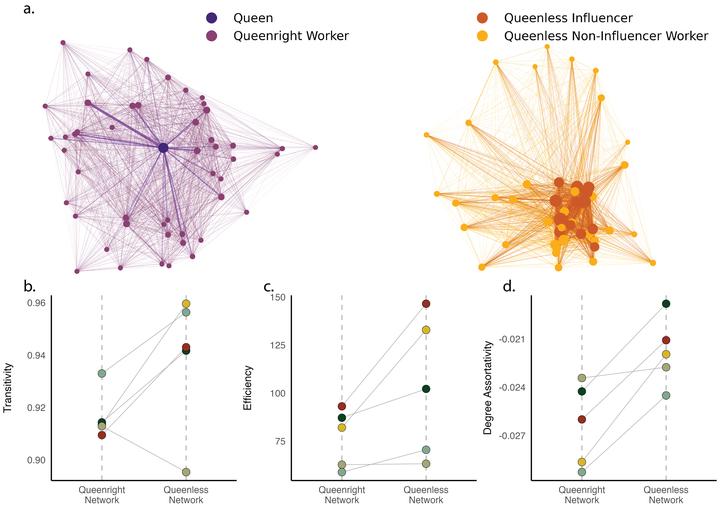
Dominant individuals often structure group organization, but less is known about how social networks reorganize in their absence and how variation among subordinates contributes to collective outcomes. Bumble bees (Bombus impatiens) provide an ideal system to study these dynamics: queens typically monopolize reproduction, but in some contexts, individual workers can adopt queen-like social roles. Using multi-animal pose tracking, we compare matched queenright and queenless partitions from the same source colonies, quantifying over 80 million social interactions. Queenless colonies exhibit increased behavioral variation and contain a subset of highly influential workers with elevated movement, spatial centrality, and reproductive activity that is absent in queenright conditions. The emergence of these individuals coincides with a shift from centralized to decentralized, efficient network architectures. These results demonstrate that queen presence constrains latent worker variation, revealing how individual behavioral differences can scale up to reshape collective social organization in hierarchical societies.

Diogo Melo
Assistant Professor
Head of the Systems Biology, Genetics and Evolution Lab (LBSGE [ləbɛɡ]) at the University of São Paulo.