evomod2
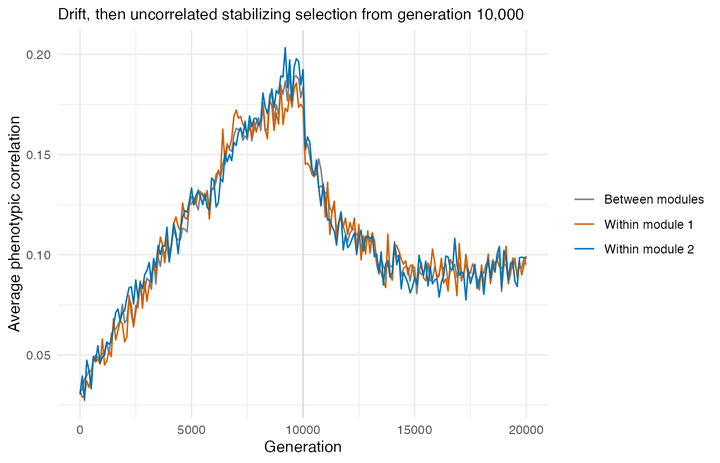 Average phenotypic correlation under drift, then stabilizing selection
evomod2 is an R package for individual-based simulations of how the genetic architecture of multivariate quantitative traits evolves. It extends the model of Melo & Marroig (2015), which showed that directional selection can drive the evolution of modularity.
Genotype-phenotype maps can be additive, multilinear epistatic, a binary ontogenetic matrix or a contribution matrix; mutation can be a random walk or house of cards; loci can be unlinked or on a genetic map; and populations can have discrete or overlapping generations, or separate sexes. The optimum can be stable, move steadily or fluctuate. The analysis tools split the genetic covariance matrix G into its pleiotropic and linkage disequilibrium parts and its additive and epistatic parts, and measure the mutational covariance matrix M. The simulation engine is written in C++ and driven from R.
The documentation includes worked examples and articles that reproduce and test published results, among them Melo & Marroig (2015) and Jones, Bürger & Arnold (2014).

Diogo Melo
Assistant Professor
Head of the Systems Biology, Genetics and Evolution Lab (LBSGE [ləbɛɡ]) at the University of São Paulo.